
Classic Car Transport in Glendale, Arizona
A classic car is rarely just transportation.
A classic car is rarely just transportation. Whether it is a numbers-matching restoration or a long-term project, the goal of transport is simple: the car arrives exactly as it left, with the same panel gaps, the same chrome and the same finish.
The physical handoff is short. A driver arrives, walks the vehicle with you, notes existing condition, loads, secures, and leaves. Most of the value in a shipment is created before that moment, in the planning that put the right truck on the right lane with the right equipment for your vehicle.
A carrier's route is a chain of commitments. Each stop influences the next, so a delay at an earlier pickup can shift the timing of yours. Well-run shipments account for that by working with realistic windows instead of single fixed times, and by keeping the customer informed as the picture becomes clearer.
Key Considerations
- Non-running classics loaded by winch rather than driven
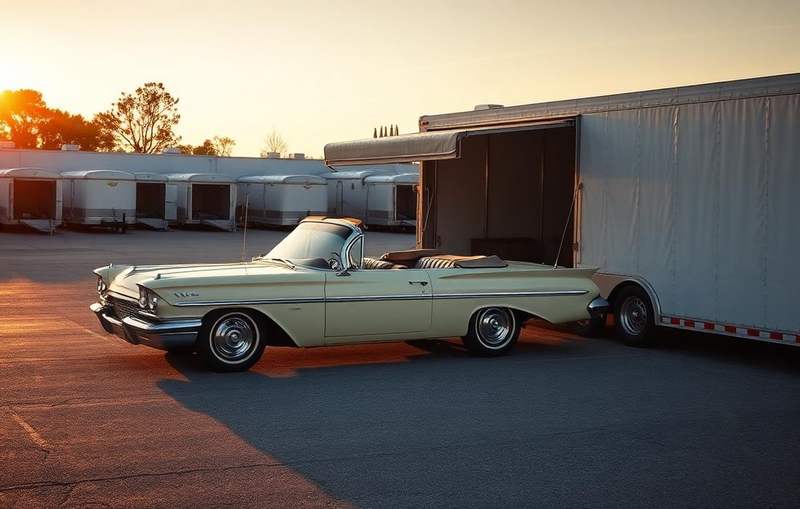
- Enclosed trailers preferred for finished restorations
- Documentation of existing chips, cracks and patina
- Fuel level, battery and fluid checks before pickup
- Discussion of declared value before the car is booked
Open transport is the default for good reason. Roughly the same conditions a vehicle faces when driven apply on an open trailer: sun, wind, rain and road dust. For a daily driver with an ordinary factory finish, that exposure is unremarkable, and the wide availability of open equipment usually means faster scheduling.
Availability differs between the two. Open carriers run constantly on Arizona lanes, so open bookings usually schedule quickly. Enclosed carriers are fewer, and enclosed shipments benefit from extra lead time, especially around collector-car events when demand concentrates sharply.
Low ground clearance is often the deciding factor rather than value. A car that cannot clear a standard ramp angle needs a hydraulic lift gate, and lift gates are far more common on enclosed equipment. If your vehicle scrapes on ordinary driveways, mention it early so the right trailer is assigned.
Preparation and Handling
Have your keys ready. Most carriers want one working key for the ignition and doors; keep your spare. If the vehicle needs a specific procedure to move in and out of transport mode, write it on a card and leave it with the driver.
Fold in the mirrors, remove roof racks, bike carriers, spoilers and any loose exterior accessory. Anything that can be removed easily should be, both to prevent damage and because protruding accessories can affect how the vehicle fits in its assigned position on the deck.
Address active fluid leaks before shipping. A vehicle on an upper deck drips onto the one below it, and carriers may decline a unit that is visibly leaking. If a leak cannot be fixed before pickup, say so when booking so it can be assigned a lower position.
Check tire pressure and battery condition before the vehicle ships. Arizona heat is hard on both. A vehicle that will not start at delivery turns a simple unload into a complicated one, and a soft tire makes loading and securing awkward for the driver.
Request a Quote
Call (602) 844-1826 or send your vehicle and route details.
Pickup, Transit and Delivery
Gated communities, apartment complexes and business parks often have their own rules about commercial vehicles. Check whether gate access, a code or advance notice is required, and whether there is a loading area the property prefers trucks to use. Sorting this out beforehand saves a wasted trip.
Plan to spend fifteen to thirty minutes at pickup. You and the driver walk the vehicle together, note its condition on the bill of lading, agree on what is recorded, and then the vehicle is loaded and secured. Read the condition notes before signing rather than after.
Pickup is arranged as a window rather than an appointment. Carriers coordinate several stops, and traffic, weather and earlier customers all shift the schedule. A window is an honest reflection of how the work happens, not an attempt to be vague.
Weather can change a schedule anywhere on a long route. Winter storms across the mountain corridors, high winds through open country and heavy rain in the southeast all slow carriers down, and none of it is negotiable when safety is involved.
Federal hours-of-service limits cap how far a driver can travel in a day. That is the mechanical reason a cross-country trip cannot be compressed, and the reason honest companies quote a window instead of a date. A carrier who is required to stop will stop.
Communication during transit is usually straightforward: contact the driver directly for location questions, or contact us for anything about the booking. Expect an update as the truck approaches the delivery region, when scheduling becomes concrete again.
Keep your copy of the completed bill of lading. Together with your own photographs, it forms the complete record of the shipment, and it is the first thing anyone will ask for if a question arises later.
Payment terms are agreed at booking and typically settle at delivery. Confirm the accepted payment methods in advance so nobody is caught out; some carriers prefer certified funds and others accept cards, and the difference is worth knowing beforehand.
Cost Factors
Pricing for classic car transport is built from a handful of measurable inputs rather than a flat rate card. Distance sets the baseline, vehicle size and weight adjust it, equipment type moves it again, and current demand on the lane finishes the calculation. Two identical cars travelling the same route in different months can carry noticeably different prices.
Flexibility is genuinely worth money. A customer who can accept a pickup within a several-day window gives the planner more routes to work with, and more options usually mean a better rate. A customer who needs a specific day narrows the field, and the price generally reflects the narrower set of choices.
To request a quote for classic car transport, the useful details are simple: both ZIP codes, the year, make and model, whether the vehicle runs, your preferred timing and whether you want open or enclosed equipment. With those in hand we can give you a realistic figure rather than a placeholder.
Operating condition affects handling. A vehicle that starts, steers, rolls and brakes can be driven onto a trailer in a minute. One that cannot needs a winch, extra time and often specific equipment, and that additional labour appears in the price. Describing the condition accurately when you request a quote avoids a revision later.
Frequently Asked Questions
What affects the cost of classic car transport?
Distance, vehicle size and weight, whether you choose open or enclosed equipment, whether the vehicle runs, how accessible both addresses are, and current demand on the lane. Because those inputs move, we quote based on your actual details rather than a fixed price list.
How long does classic car transport usually take?
Short trips within Arizona are often completed in a day or two, regional routes typically take one to three days, and cross-country moves generally fall in a seven to ten day range. These are realistic estimates rather than guarantees, since weather, traffic and hours-of-service rules all affect a route.
How should I prepare my vehicle?
Wash it, photograph it in daylight, remove personal belongings and exterior accessories, leave about a quarter tank of fuel, check tire pressure and battery condition, disable alarms and toll transponders, and be ready to hand over one working key.
Should I choose open or enclosed transport?
Open transport suits most standard vehicles and schedules faster. Enclosed transport suits collector, exotic, low-clearance and freshly restored vehicles, and anyone who wants the finish protected from road debris and weather. We are happy to talk it through.
How far in advance should I book?
A week or more of lead time gives the most flexibility, and longer is helpful during the autumn and spring seasonal peaks in Arizona. Shorter notice is often workable when the lane has available capacity, so it is always worth calling.
What happens if something is wrong at delivery?
Note it on the bill of lading before you sign, photograph it immediately, and contact us the same day. The condition report from pickup is the comparison point, which is why the inspection at both ends matters so much.
Speak With Our Glendale Team
Call (602) 844-1826 for straightforward answers about your vehicle.
Continue Exploring
Nearby Service Areas
Start at our vehicle shipping home page, compare every option on the services overview, or contact our Glendale office.